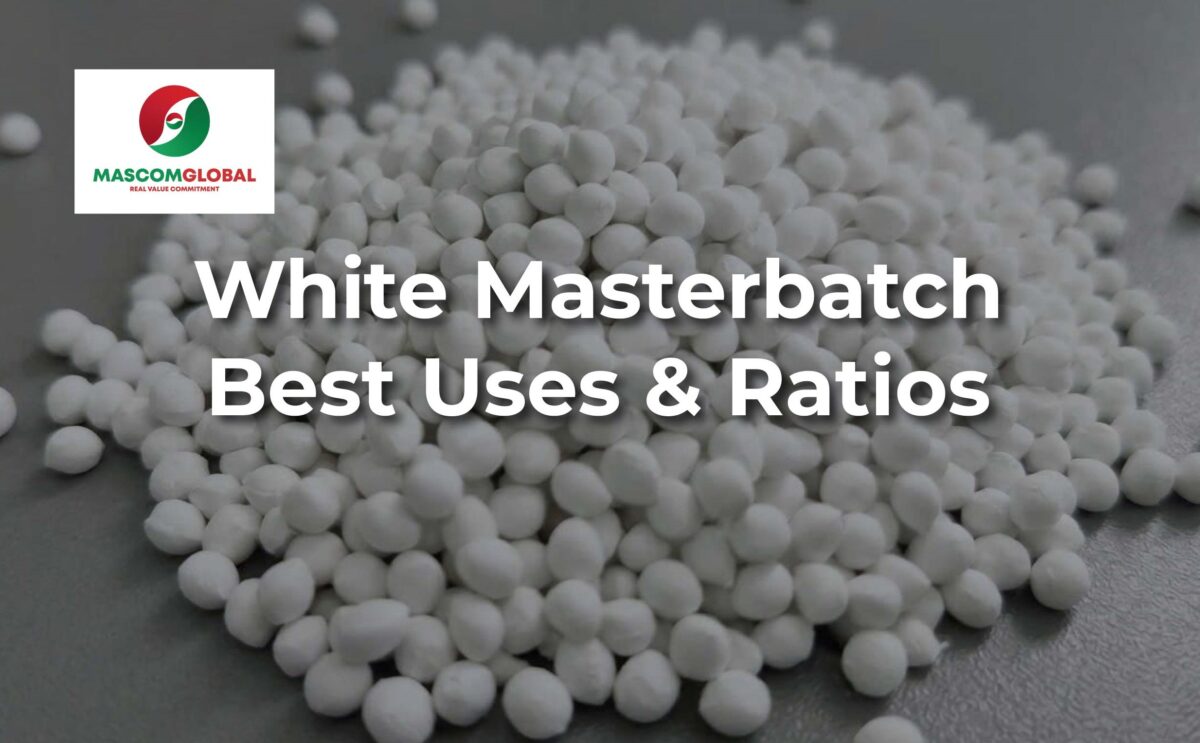
In the plastics processing industry, White Masterbatch (titanium dioxide/TiO2 color masterbatch) is one of the most fundamental and widely used additive categories. From supermarket shopping bags, cosmetic bottles, and agricultural mulch to electronic housings, a pure white hue does not merely enhance visual appeal - it dictates opacity, opacity performance, and UV protection in finished plastic items.
However, how much white masterbatch is enough for your production? How can plastic processors minimize raw material costs without running into technical flaws like bubble defects, film tearing, or color streaking?
Join Mascom Global as we break down the most popular applications and exact dosage formulations tailored to each plastic manufacturing technology below.
What Is White Masterbatch Composed Of?

The overall performance of white color masterbatch relies heavily on its primary active ingredient: Titanium Dioxide (TiO2) - a white pigment offering the highest light reflectivity and refractive index available today.
Common White Masterbatch Applications & Standard Let-Down Ratios
Every plastic processing technology demands a tailored white masterbatch structure regarding Melt Flow Index (MFI), pigment particle size distribution, and dispersion characteristics. Depending on the required opacity and product thickness, the recommended Let-Down Ratio (LDR) for Mascom White Masterbatch can be adjusted flexibly:
1. Film Blowing Technology
Film blowing represents one of the largest application sectors for white masterbatch, encompassing supermarket T-shirt bags, zipper bags, shrink films, agricultural mulch, and food packaging. In this process, the white masterbatch requires exceptionally fine pigment dispersion to ensure ultra-thin film drawdown without pinholes, tearing, or "fish-eyes". The recommended let-down ratio typically ranges from 1% to 5% when utilizing high-concentration grades (containing 60% to 70% TiO2).
2. Injection Molding
For consumer housewares, washing machine housings, food containers, children's toys, and automotive components, white masterbatch delivers rich opacity and a sleek, modern gloss finish. The core technical requirement for injection molding is high thermal stability (up to 300°C) without yellowing or thermal degradation, alongside zero product warping upon mold release. Standard let-down ratios in this field typically range between 1% and 3% (using grades with 50% to 60% TiO2).
3. Blow Molding & Thermoformed Packaging
In the manufacturing of cosmetic bottles, dairy containers, chemical jerrycans, and pharmaceutical jars, White Masterbatch creates a smooth aesthetic while acting as a vital light barrier, shielding sensitive liquid formulas from UV radiation. To achieve this deep white hue and opacity, processors generally incorporate white masterbatch at a let-down ratio of 2% to 6% (utilizing masterbatches with 50% to 70% TiO2 concentration).
4. Sheet, Pipe & Profile Extrusion
Extruded plastic products such as ceiling panels, uPVC profiles, water conduits, and food trays require white masterbatch to deliver superior weather resistance, impact strength, and resistance to yellowing under prolonged sunlight exposure. The usage ratio for extrusion applications generally spans from 2% to 8% (using 40% to 60% TiO2 content).

(Illustrative purpose only)
5. Raffia & Non-Woven Fiber Extrusion
This is the most technically demanding segment for white color masterbatch. Applications in PP woven sacks, flexible intermediate bulk containers (FIBC), medical face masks, and non-woven fabrics require micro-fine TiO2 particle size distribution to keep the Filter Pressure Value (FPV) at an absolute minimum. This prevents yarn breakage during high-speed thermal stretching. The ideal let-down ratio for fiber spinning typically ranges from 1.5% to 4% (utilizing 50% to 70% TiO2 masterbatch grades).
Critical Factors When Choosing White Masterbatch
To optimize operational expenses, plastic production engineers should consider 3 crucial criteria:
- TiO2 Loading Percentage: Selecting masterbatches with high TiO2 concentration (e.g., 60% - 70%) allows you to lower the let-down ratio in your equipment, saving significantly on freight and warehousing costs.
- Carrier Resin Compatibility: The carrier polymer of the masterbatch must match or be fully compatible with your base resin (PE carrier for PE, PP for PP) to prevent delamination or mechanical strength degradation.
- Thermal Stability & Zero White Specks: Inferior masterbatch grades undergo thermal degradation causing yellowish discoloration, or leave un-dispersed TiO2 specks and streaks on the finished product.
Premium White Masterbatch Solutions by Mascom Global
Boasting a massive annual capacity of 240,000 metric tons and state-of-the-art twin-screw extrusion equipment, Mascom Global supplies international-grade White Masterbatches:
- Exceptional Opacity & Whiteness: Formulated with 100% pure Rutile TiO2 sourced from premier global chemical vendors, ensuring brilliant, high-gloss whiteness.
- Flawless Dispersion Technology: Micro-fine TiO2 particles are fully encapsulated in the carrier resin matrix, eliminating clumping and filter clogging in high-speed spinning or film lines.
- Uncompromised Safety: Fully certified under ISO 9001:2015, RoHS, REACH, and FDA guidelines - making it completely safe for food packaging, pharmaceuticals, and exported children's toys to the US, EU, and Japan.
- Tailored Formulations (Customized Grades): Mascom's R&D team is equipped to customize TiO2 concentrations and Melt Flow Index (MFI) to align perfectly with your factory's processing parameters.
Request Free Testing Samples & Technical Consultation
Are you searching for a high-performance White Masterbatch solution that optimizes dosage ratios and slashes production costs for your facility?
Contact Mascom Global today for specialized technical support and to claim your free trial samples!