Blog
What is BOPE Film? Application of Filler Masterbatch in BOPE film production
Across Asia’s plastic packaging industry, sustainability is no longer optional. Governments, brand owners, and export-oriented manufacturers are under increasing pressure to adopt recyclable, mono-material packaging solutions while still maintaining competitive production costs. In this context, BOPE film (Biaxially Oriented Polyethylene) is emerging as one of the most promising alternatives to traditional multi-layer laminates such as BOPP/PE or PET/PE, which are difficult and costly to recycle.
However, BOPE film production comes with higher resin costs and stricter processing requirements. For Asian manufacturers competing on price, the key question is:
How can BOPE be produced at scale while remaining economically viable?
The answer lies in the strategic use of high-quality PE Filler Masterbatch.
As a leading masterbatch manufacturer in Vietnam, Mascom Global shares practical insights into BOPE technology, its benefits, and how engineered filler masterbatch helps Asian converters balance performance, sustainability, and cost efficiency.
What Is BOPE Film?
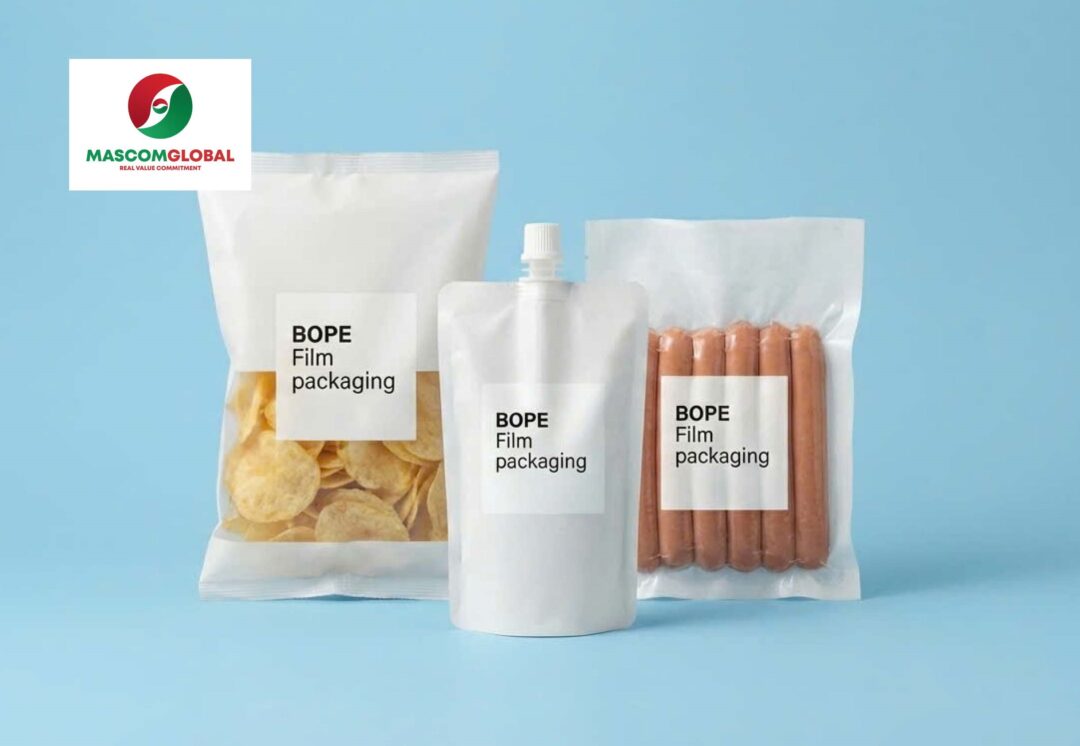
BOPE (Biaxially Oriented Polyethylene) is a polyethylene film produced by stretching the molten PE sheet in two directions:
- Machine Direction (MD) – along the extrusion flow
- Transverse Direction (TD) – perpendicular to the flow
This biaxial orientation aligns polymer chains, significantly improving mechanical and optical properties compared to conventional blown or cast PE films.
Key Advantages of BOPE Film
Compared to standard LDPE or LLDPE film, BOPE offers:
- Higher transparency and gloss (approaching BOPP in many applications)
- Increased stiffness and modulus
- Improved tensile strength and puncture resistance
- Excellent downgauging capability
- Full compatibility with mono-material PE packaging structures
Most importantly, BOPE enables all-PE recyclable packaging, making it highly attractive for Asian exporters targeting Europe, Japan, and North America.
The Cost Challenge of BOPE Film in Asia
While BOPE offers sustainability benefits, it introduces several challenges for manufacturers in Asia:
- Higher cost of specialty PE resins for orientation
- Narrow processing window during stretching
- Increased risk of film breakage and defects
- Higher sensitivity to raw material quality
To remain competitive, manufacturers must optimize formulation without sacrificing BOPE’s core performance. This is where PE Filler Masterbatch plays a critical role.
Why Filler Masterbatch Is Essential in BOPE Film Production?
1. Cost Optimization Without Compromising Recyclability
Calcium carbonate (CaCO3) based PE Filler Masterbatch partially replaces virgin PE resin, significantly reducing material cost.
Mascom Global’s PE filler masterbatch typically contains 70–84% high-purity CaCO3, allowing manufacturers to:
- Lower raw material costs
- Improve margin stability
- Maintain mono-material PE recyclability
This is especially important for Asian markets, where price sensitivity remains high.
2. Improved Stiffness and Film Handling
Contrary to common misconceptions, properly selected CaCO3 filler can enhance BOPE film properties when well dispersed and correctly oriented:
- Increased stiffness and modulus
- Better web handling on high-speed packaging lines
- Improved bag making and sealing performance
This makes BOPE a practical replacement for BOPP in many packaging formats.
3. Natural Antiblock Effect
Ultra-fine CaCO3 particles act as a natural antiblock agent, reducing film-to-film adhesion during winding and converting.
Benefits include:
- Improved roll unwinding
- Higher line speed
- Reduced blocking issues in hot Asian climates
4. Reduced Carbon Footprint
From a sustainability perspective, calcium carbonate has a much lower carbon footprint than petrochemical polymers.
By increasing mineral content in BOPE film, manufacturers can:
- Reduce fossil-based plastic usage
- Lower overall CO₂ footprint
- Support ESG and sustainability reporting requirements
Why Standard Filler Masterbatch Fails in BOPE Applications?
BOPE film undergoes intensive stretching (often 4–6 times in both MD and TD). During this process, filler quality becomes critical.
Low-quality filler masterbatch often leads to:
- Cavitation and void formation
- Film breakage during orientation
- Increased haze and loss of transparency
- Reduced tensile strength
These issues typically arise when:
- CaCO3 particle size is too large
- Dispersion is inconsistent
- Carrier resin is incompatible with BOPE base resin
Mascom Global’s BOPE-Grade Filler Masterbatch Solution
At Mascom Global, BOPE applications are treated as precision engineering, not commodity blending.
1. Ultra-Fine Particle Size and High Purity
- Natural calcite CaCO3 purity >99%
- Whiteness >96%
- Controlled D50 particle size: 1–3 µm
This ensures smooth stretching during orientation and minimizes cavitation risk.
2. Advanced Dispersion Technology
Using high-torque twin-screw extrusion lines, Mascom ensures:
- Uniform CaCO₃ coating
- Zero agglomeration
- Stable dispersion across thin BOPE gauges
This is critical for Asian manufacturers running long production cycles.
3. Optimized Flow Compatibility
Mascom’s PE filler masterbatch uses high-quality LLDPE/LDPE carriers, offering:
- Excellent compatibility with BOPE resins
- Melt Flow Index (MFI) tailored for film orientation
- Stable pressure and output during extrusion
Available MFI ranges cover both blown and cast BOPE processes.
4. Regulatory Compliance for Export Markets
Mascom Global filler masterbatch meets international standards required by Asian exporters:
- FDA approved for food contact
- REACH & RoHS compliant
- ISO 9001:2015 certified production
Supporting Asia’s Transition to Sustainable Packaging
With over 240,000 tons/year production capacity, Mascom Global supports packaging manufacturers across 70+ countries around the world.
Beyond supplying masterbatch, Mascom provides:
- Formulation support
- BOPE trial assistance
- Custom filler grades based on stretching ratio and film thickness
Conclusion
BOPE film represents the future of recyclable flexible packaging in Asia, but its success depends on achieving the right balance between performance, cost, and process stability.
By integrating engineered PE Filler Masterbatch, manufacturers can:
- Reduce raw material costs
- Improve stiffness and runnability
- Maintain recyclability
- Scale BOPE production confidently
Mascom Global is committed to helping Asian converters adopt BOPE technology efficiently – delivering not just filler masterbatch, but real, measurable value for sustainable packaging growth.
