
Blog
Advanced Manufacturing Processes for High-Performance Additive Masterbatch – Mascom Global
At Mascom Global, we recognize that an additive masterbatch is not merely a commodity; it is a precision-engineered tool designed to modify the fundamental properties of polymers — enhancing stability, processability, surface characteristics, or longevity.
The challenge in manufacturing additive masterbatches — distinct from standard color pigment manufacturing — lies in the incredibly high concentration of active ingredients, often ranging from 10% up to 70% or more, incorporated into a polymer carrier. Achieving thermodynamic compatibility and microscopic dispersion of these often distinct chemical entities (such as polar additives in non-polar polyolefins) requires more than just melting plastic; it demands a rigorous adherence to chemical engineering principles and rheological control.
Below is a detailed explication of the production protocol employed at Mascom Global’s state-of-the-art manufacturing facility. This process reflects years of optimization, designed to ensure batch-to-batch consistency and superior performance in our customers’ final applications, be it blown film, injection molding, or fiber spinning.
Stage 1: Raw Material Intake, Characterization, and Rigorous Validation
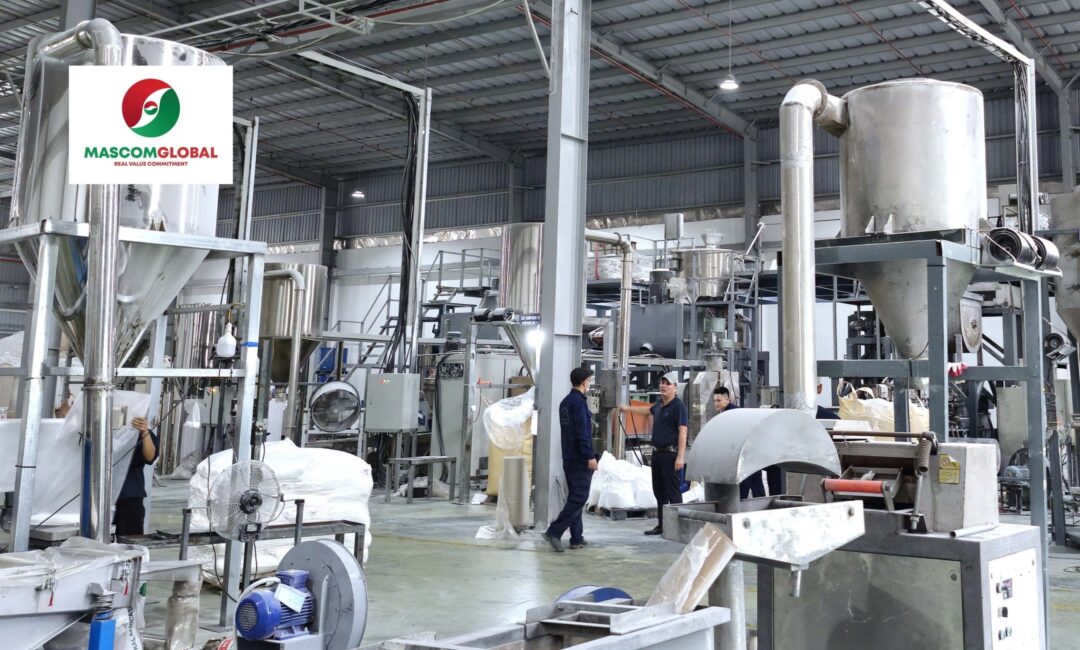
The foundation of any high-performance additive masterbatch is the quality of its constituent components. At Mascom Global, we operate under a “trust but verify” mandate regarding suppliers’ Certificates of Analysis (CoA).
Upon arrival, carrier resins (LDPE, LLDPE, PP, PS, PET, PA, etc.) are subjected to rheological testing. We utilize Melt Flow Indexers to verify MFI/MVR, ensuring the carrier resin’s viscosity is sufficiently lower than the target end-use polymer to facilitate proper “let-down” and dispersion, yet high enough to maintain pellet integrity during high-loading compounding.
Crucially, the active additive masterbatch components — ranging from hindered amine light stabilizers (HALS) and phenolic antioxidants to complex migrating slip agents (erucamide/oleamide) and inorganic anti-blocks (synthetic silica, talc) — undergo rigorous scrutiny. We analyze particle size distribution (PSD) using laser diffraction, as oversized particles are the primary cause of filter pressure rise and surface defects in thin-gauge films. Moisture content is verified via Karl Fischer titration, particularly for hygroscopic additives, as retained moisture leads to hydrolytic degradation and lacing during extrusion.
Only materials that fall within narrow, pre-defined specifications are released by QC into our silo systems or climate-controlled warehouse zones.
Stage 2: Precision Formulation and Gravimetric Dosing
In high-concentration additive masterbatches, stoichiometry is critical. A slight deviation in the ratio of a synergistic antioxidant blend or an incorrect dosage of a coupling agent can drastically alter the final product’s performance.
Mascom Global has moved entirely away from manual pre-weighing for critical components. We utilize multi-component gravimetric dosing stations located directly above the extruder feed throat. These Loss-in-Weight (LIW) feeders continuously monitor the mass flow rate of each ingredient — pelletized carrier, powder additives, and liquid modifiers — adjusting screw speeds in milliseconds to maintain the precise formulation ratio regardless of bulk density fluctuations.
For handling difficult ingredients, such as ultra-low bulk density fumed silica or highly cohesive, fatty amides that tend to bridge, we employ specialized feeder agitators and twin-screw micro-feeders to ensure consistent dosing without pulsing. This stage eliminates human error and ensures compositional accuracy to within ±0.5%.
Stage 3: The Core Process – Reactive Compounding via Twin-Screw Extrusion
The heart of our operation is the compounding hall, housing a fleet of co-rotating, fully intermeshing twin-screw extruders ranging from laboratory-scale 26mm lines to high-output 92mm production behemoths.
Unlike single-screw extrusion used in final part fabrication, twin-screw extrusion is essential for masterbatch manufacturing due to its modular screw design and superior mixing capabilities. We calculate the specific energy input (SEI) required for each formulation to achieve dispersion without causing thermal or shear degradation to sensitive additives.
Screw Profile Design:
Our process engineers customize the screw configuration (screw profile) for each additive family. A typical profile includes:
- Feeding Zone: Deep-flighted conveying elements to maximize intake of low-bulk-density powders.
- Melting Zone: Utilizing kneading blocks with specific staggering angles (e.g., 30° or 60° forward) to introduce mechanical energy and melt the carrier resin via shear heating.
- Mixing/Dispersion Zones: This is critical. We employ high-shear kneading blocks and sometimes reverse-flow elements to create intense turbulence. The goal is to break down additive agglomerates (distributive mixing) and coat individual primary particles with the polymer melt (dispersive mixing). For shear-sensitive additives like certain flame retardants, we utilize gentler mixing elements to prevent chemical breakdown.
- Degassing Zone: A high-vacuum venting port is situated approx two-thirds down the barrel. This is essential to remove entrapped air, moisture, and any volatiles generated during processing, ensuring a porosity-free pellet.
- Metering Zone: Final conveying elements to build sufficient pressure for the die head.
Temperature Profile:
We utilize precise multi-zone barrel temperature controls. The profile is typically “humped” — cooler at the feed throat to prevent premature melting and bridging, peaking in the mixing zones to ensure complete melting and reaction activation (if coupling agents are used), and cooling slightly towards the die to stabilize melt strength for pelletizing.
Stage 4: Melt Filtration and Pelletization Technology
Before shaping, the polymer melt must be filtered. We employ continuous screen changers with filtration fineness dictated by the final application. For film-grade masterbatches, we may filter down to 40-60 microns to ensure no agglomerates pass through. We continuously monitor backpressure before the screen changer; a rapid pressure rise indicates poor upstream dispersion or contaminated raw materials.
Following filtration, the melt is converted into solid pellets. Mascom Global utilizes two primary techniques depending on the formulation’s rheology:
- Strand Pelletizing: The melt is extruded through a multi-hole die into water strands, cooled in a water bath, dried via air knives, and cut by a rotary pelletizer. This is standard for many polyolefin-based additives.
- Underwater Pelletizing (UWP): For highly loaded masterbatches, low-viscosity carriers, or tacky formulations (like high-slip or PIB masterbatches), strand pelletizing is impractical due to strand breakage. UWP cuts the melt directly at the die face completely submerged in pressurized, temperature-controlled water. The spherical pellets are instantly cooled and conveyed by the water slurry to a centrifugal dryer. This method ensures uniform pellet geometry and minimal dust.
Stage 5: Post-Production Treatment and Classification
The pellets exiting the dryer are not yet ready for packaging. They pass through a multi-deck classifying screen (vibro-sieve). This unit removes “overs” (doubles or married pellets) and “fines” (dust and micro-pellets). Uniform pellet size is crucial for our customers to ensure consistent feeding in their own extruders.
For moisture-sensitive products, such as those containing hygroscopic anti-stats or certain nucleating agents, the classified pellets are diverted to desiccant dehumidifying dryers to bring moisture content down to sub-500 ppm levels before packaging.
Stage 6: Final Quality Control – The Performance Guarantee
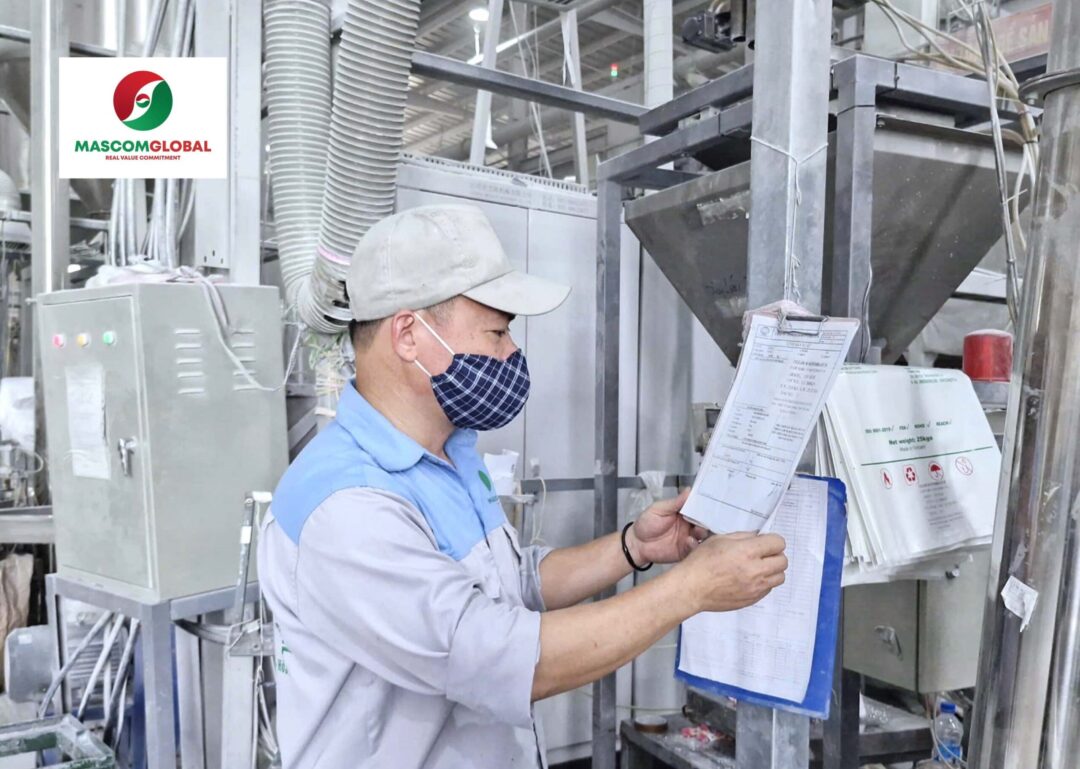
At Mascom Global, production ends not with packaging, but with validation. Samples are drawn at regular intervals during the run for QC testing.
Besides standard checks for Bulk Density, Melt Flow Index (MFI), and moisture, we perform application-specific functional tests:
- Ash Content / TGA (Thermogravimetric Analysis): To verify the precise percentage of inorganic loading (e.g., talc, silica, CaCO3).
- Filter Pressure Value (FPV) Test: This is perhaps the most critical test for dispersion quality. We run a specified amount of masterbatch diluted with virgin resin through a laboratory extruder fitted with a very fine mesh screen pack (typically 25 or 14 microns depending on DIN standards). We measure the pressure rise over time. A low pressure rise indicates excellent dispersion of active ingredients; a high rise indicates the presence of undispersed agglomerates that would cause failures in thin-film applications.
- Film Blowing Test: For critical film additives, we produce a small lab-scale blown film sample to visually inspect for gels, specks, and surface defects, and to test functional properties like COF (Coefficient of Friction) for slip masterbatches.
Only when a batch meets all technical parameters on the specification sheet is it released for packaging.
Conclusion
The production of additive masterbatch is a complex discipline sitting at the intersection of polymer chemistry, rheology, and mechanical engineering. Over my 20 years in this field, I have learned that shortcuts inevitably lead to field failures.
At Mascom Global, our manufacturing protocol is designed to eliminate variables. By combining rigorous raw material validation, high-precision gravimetric feeding, sophisticated twin-screw compounding technologies, and stringent post-production testing, we ensure that our additive masterbatches deliver the exact functional performance our clients demand, batch after batch, year after year. This is not just manufacturing; it is material science into practice.
