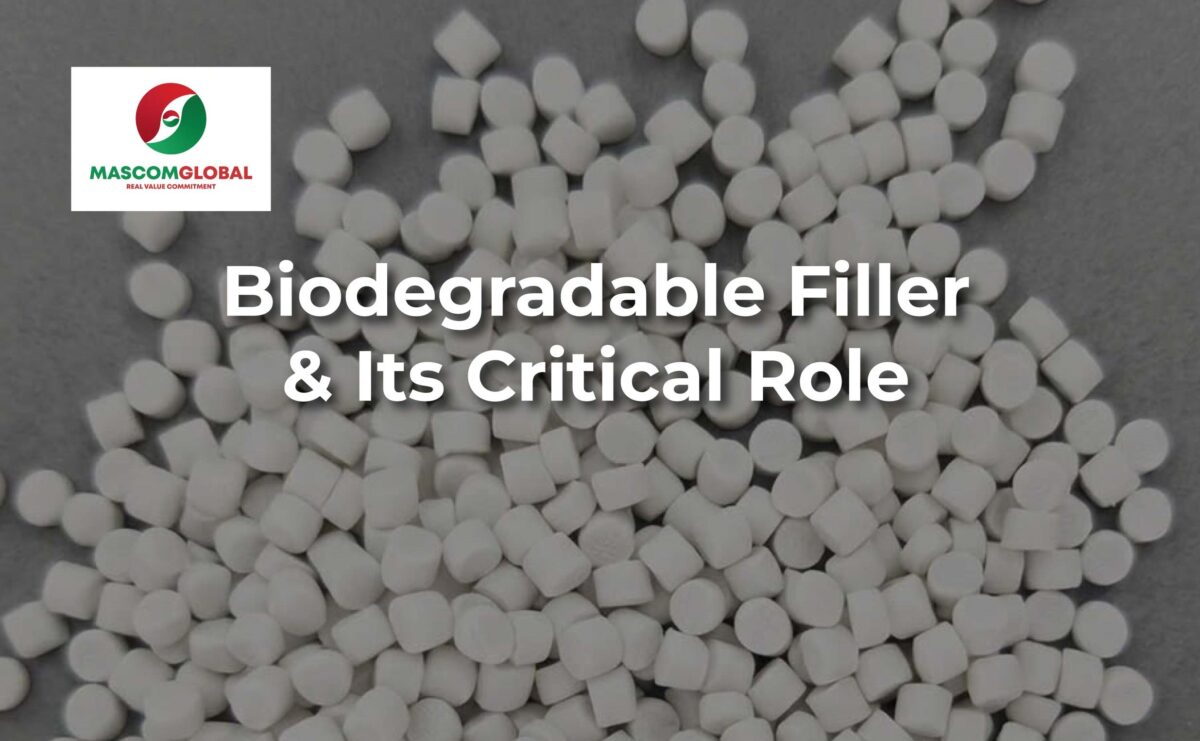
[MASCOM GLOBAL] What is biodegradable filler, what are its functions, and how is it applied in real-world manufacturing? Let’s explore in detail below.
What is Biodegradable Filler?

Biodegradable filler is an additive or filling material incorporated into plastic production that can naturally decompose under the influence of microorganisms, moisture, temperature, or biological environments.
Unlike traditional fillers such as calcium carbonate (CaCO₃) or talc, bio fillers are designed to:
- Reduce the use of virgin plastic materials
- Enhance the degradability of plastic products after disposal
- Minimize long-term environmental impact
Common types of biodegradable fillers include:
- Natural starch-based fillers
- Cellulose
- PLA (Polylactic Acid)-based additives
- Natural fibers (wood flour, bamboo fiber)
- Bio-polymer blends
Thanks to their compatibility with polymers such as PLA, PBAT, PBS, and certain blended systems, bio fillers have become an important component in the bio-plastics industry.
Mechanism of Biodegradable Filler
Bio fillers work based on the principle of biological decomposition. When plastic products are discarded into the environment, factors such as:
- Bacteria
- Fungi
- Moisture
- Oxygen
- Temperature
act on the material structure, breaking down polymer chains into simpler compounds such as CO₂, water, and biomass.
During this process, bio fillers play several roles:
- Creating weak points within the polymer matrix
- Increasing water and oxygen permeability
- Supporting microbial activity for faster degradation
As a result, plastic products can break down faster compared to conventional plastics under suitable environmental conditions.
Advantages of Biodegradable Filler in Plastic Manufacturing
-
Reducing Environmental Impact
This is the most important advantage. The use of bio fillers helps:
- Reduce non-degradable plastic waste
- Minimize soil and ocean pollution
- Support circular economy development
This is especially important as many countries are tightening regulations on single-use plastics.
-
Reducing Raw Material Costs
Some bio fillers are more cost-effective than virgin polymers, helping manufacturers:
- Optimize production costs
- Lower final product prices
- Improve market competitiveness
-
Improving Product Physical Properties
Depending on the formulation, bio fillers can help:
- Increase product rigidity
- Improve surface printability
- Adjust surface roughness or opacity
- Modify mechanical properties
-
Enhancing Green Brand Value
Products using eco-friendly materials can more easily:
- Achieve green certifications
- Attract environmentally conscious consumers
- Align with ESG business trends
Limitations of Biodegradable Filler
Despite its advantages, biodegradable filler still has some limitations:
-
Reduced Mechanical Properties
Adding bio fillers may result in:
- Lower tensile strength
- Reduced flexibility
- Lower impact resistance
-
Specific Degradation Conditions Required
Not all products degrade quickly in natural environments. Some require:
- Industrial composting conditions
- Suitable humidity and microbial activity
-
Limited Compatibility
Not all polymers are compatible with biodegradable fillers, requiring:
- Formulation adjustments
- Use of compatibilizers
Applications of Biodegradable Filler in the Plastics Industry

(Illustrative purpose only)
-
Biodegradable Packaging
This is the largest application area of bio fillers.
Products include:
- Biodegradable plastic bags
- Food packaging
- Wrapping films
Requirements:
- Food safety compliance
- Fast degradation ability
- Sufficient durability during usage
-
Disposable Products
Products such as:
- Plastic spoons, forks, and knives
- Disposable cups
- Food containers
are designed to reduce long-term plastic waste.
-
Agriculture
Bio fillers are used in:
- Agricultural mulch films
- Seedling pots
- Biodegradable plant ties
Advantages:
- No need for post-use collection
- Natural decomposition in soil
-
Eco-Friendly Consumer Products
Including:
- Biodegradable toys
- Sustainable packaging materials
- Eco-friendly lifestyle products
Development Trends of Biodegradable Filler
In recent years, bio fillers have grown rapidly due to:
- Regulations banning single-use plastics in many countries
- Increasing demand for green consumption
- Advancements in bio-based materials (PLA, PBAT, PHA)
Current trends focus on:
- Faster degradation performance
- Improved mechanical strength
- Blending with recycled plastics
- Cost optimization for large-scale production
In the future, bio fillers are expected to become not just additives, but core components of sustainable polymer systems.
Conclusion
Biodegradable filler is an important solution in the transition toward a greener plastics industry. With its ability to support biodegradation, reduce environmental impact, and optimize production costs, this material is increasingly applied across packaging, agriculture, and consumer product sectors.
Although it still has limitations in mechanical strength and degradation conditions, continuous advancements in material science are expected to make bio fillers an essential part of the future polymer industry.
Alongside bio-based material solutions, optimizing color and product aesthetics also plays a key role in market competitiveness. With extensive experience in plastic additives and color solutions, Mascom Global provides a wide range of Color Masterbatch, Filler Masterbatch, and Additive Masterbatch, helping manufacturers enhance product value, ensure color consistency, and meet technical requirements across various plastic applications.