
Blog
PE Taical vs. PP Taical: Differences
In the plastics industry — where cost optimization, productivity, and product quality are constantly pushed to higher standards — Filler Masterbatch a.k.a Taical (CaCO₃- based) has become an indispensable material. Among the most widely used types today are PE Taical and PP Taical. Though both share a common CaCO₃ foundation, their properties and performance differ significantly.
Understanding these differences is essential for manufacturers aiming to reduce raw material costs, improve production efficiency, and enhance end-product quality.
Drawing from practical experience at Mascom Global — a leading producer of Filler Masterbatch trusted by factories across Asia, Europe, the Americas, and Africa — this article provides an in-depth comparison to help you choose the right filler for your specific application.
1. Overview of PE Taical and PP Taical
1.1 PE Taical
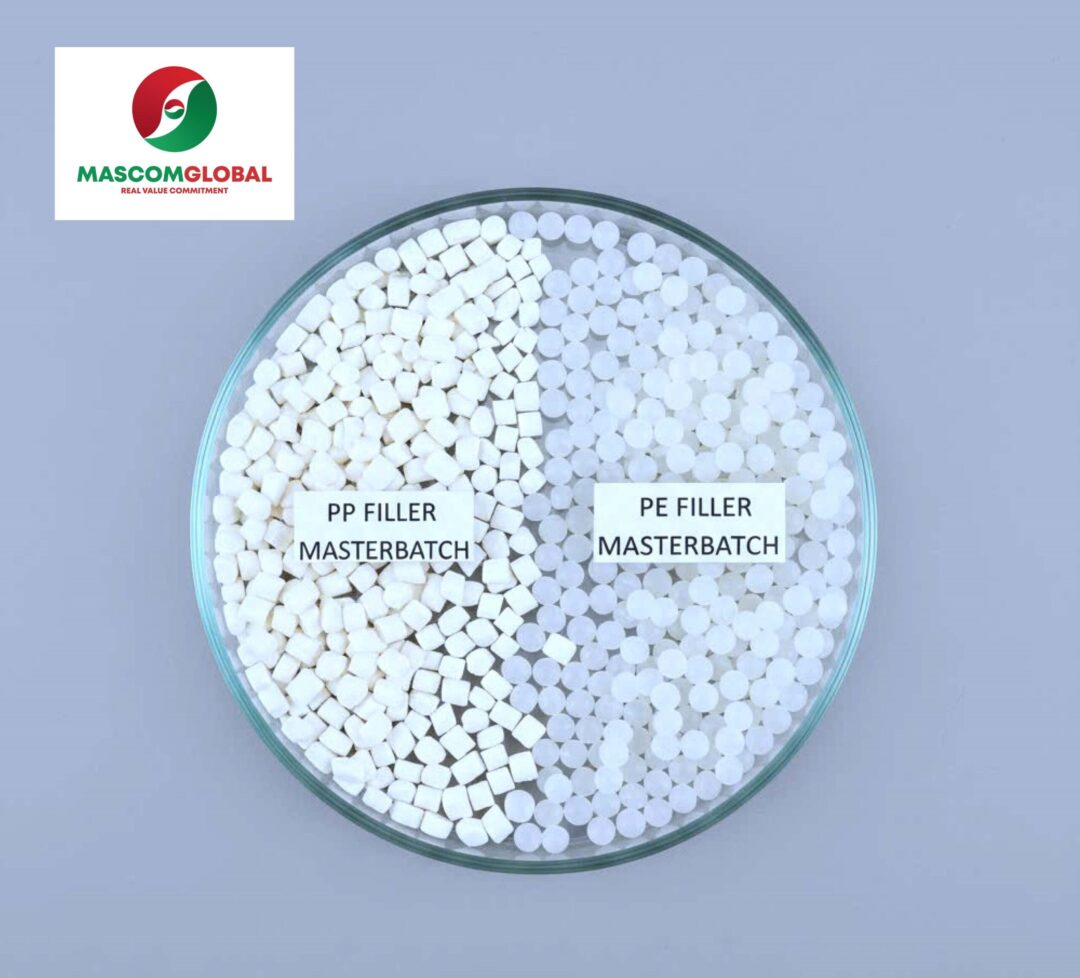
PE Taical (PE Filler Masterbatch CaCO3) is produced from a Polyethylene base resin (LDPE, LLDPE, or HDPE), CaCO₃ powder, and suitable additives.
Advantages:
- Low processing temperature
- High flexibility
- Smooth surface
- Excellent dispersion in soft and flexible film applications
1.2 PP Taical
PP Taical (PP Filler Masterbatch CaCO3) uses a Polypropylene base resin combined with CaCO₃ and additives, making it ideal for applications requiring higher stiffness and tensile strength.
Advantages:
- Superior tensile strength
- High rigidity
- Excellent thermal stability
- Suitable for high-speed stretching and extrusion processes
Mascom Global leverages these characteristics to produce customized Filler Masterbatch grades for blown film, PP nonwoven, raffia, PP injection molding, industrial films, and more.
2. Detailed Comparison of PE Taical vs. PP Taical
2.1 Mechanical Properties
| Mechanical Property | PE Taical | PP Taical |
| Flexibility | High | Medium – Low |
| Tensile Strength | Good | Excellent |
| Stiffness | Low | High |
| Impact Resistance | Good | Moderate |
➡ PP Taical suits rigid products requiring high strength.
➡ PE Taical is ideal for soft, thin, flexible films.
2.2 Processing Performance
| Processing Factor | PE Taical | PP Taical |
| Processing Temperature | Low | High |
| Extrusion Speed | High | Very High |
| Energy Consumption | Low | Medium |
| Thermal Stability | Medium | High |
Mascom Global’s advanced European-standard production lines ensure:
- Lower extrusion pressure
- Reduced friction
- Excellent CaCO₃ dispersion
- 8 – 12% higher output
- 5 – 10% lower energy consumption
2.3 Polymer Compatibility
- PE Taical → LDPE, LLDPE, HDPE, EVA
- PP Taical → PP raffia, PP injection molding, PP film, PP sheet
Incorrect selection can lead to:
- Surface micro-voids
- Reduced strength
- Hazy films
- Raffia yarn breakage
- Poor dispersion
Mascom Global prevents these issues by using 100% virgin PE/PP carrier resins, ensuring perfect compatibility with CaCO₃ particles.
2.4 Surface Quality & Optical Properties
| Property | PE Taical | PP Taical |
| Gloss | Good | Very Good |
| Smoothness | Excellent | Good |
| Shrinkage Stability | Good | Excellent |
➡ PP fillers deliver a glossier, harder surface.
➡ PE fillers deliver smoother, more flexible film surfaces.
2.5 Economic Benefits
The primary benefit of Filler Masterbatch is reducing virgin resin consumption while maintaining or improving product performance.
- In raffia applications, high-quality PP Taical can be used at up to 50% loading without loss of strength — an advantage strongly demonstrated by Mascom Global’s PP grades.
- In blown film, PE Taical can also be used at high loading levels (up to or above 50%) while preserving film quality.
3. Applications of PE Taical and PP Taical
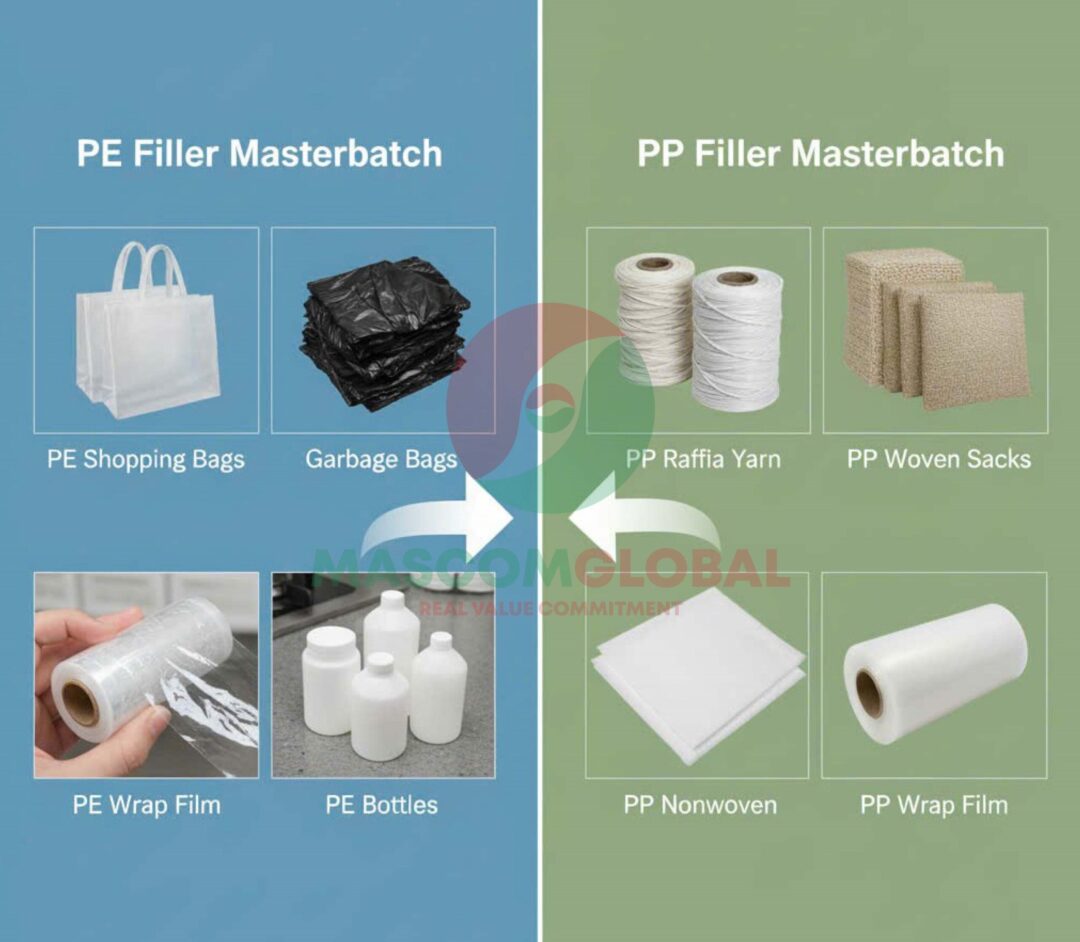
3.1 PE Taical Applications
- LDPE/LLDPE/HDPE blown film
- Shopping bags, garbage bags
- Agricultural film
- PE flexible hoses
- Industrial films
- Bottles and containers
➡ Best for soft, flexible, thin film products.
3.2 PP Taical Applications
- Raffia yarn
- Woven sacks
- PP hollow sheets
- PP injection molding
- PP film
- PP nonwoven
➡ Ideal for rigid, strong products and high-speed stretching processes.
Mascom Global provides application-specific grades ensuring:
- Reduced yarn breakage
- Stripe-free films
- Smooth surfaces
- Higher output
- Consistent dispersion
4. Should You Choose PE Taical or PP Taical?
Choose PE Taical if you need:
- Soft, flexible products
- Smooth surface finish
- Low-temperature processing
- Blown film or thin bag applications
Choose PP Taical if you need:
- High tensile strength
- Rigid, glossy surfaces
- Dimensional stability
- High-speed raffia or extrusion
Mascom Global supports customers by recommending the right filler based on:
- Product requirements
- Machine configuration
- Line speed
- Optimal dosing ratio
5. What Makes Mascom Global’s Taical Different?
Mascom Global is highly trusted for its:
- Ultra-fine CaCO₃ with >98% purity
- Advanced surface treatment for perfect dispersion
- 100% virgin PE/PP carrier resin
- Consistent quality in every batch
- Experienced technical team offering strong on-site support
Real-world customer results:
- 8 – 12% higher productivity
- 5 – 10% less energy consumption
- Improved surface appearance
- Lower defect rate
- Less machine and die cleaning required
6. Conclusion
Both PE Taical and PP Taical provide significant economic and technical advantages. The key to maximizing performance is selecting the correct carrier resin and application-specific grade. With premium CaCO₃ sources, modern production technologies, and expert technical support, Mascom Global is committed to delivering optimized Filler Masterbatch solutions — helping manufacturers boost output, reduce costs, and maintain stable long-term quality.
