
Blog
Understanding HDPE Pipe Fittings & the Strategic Application of Filler Masterbatch in Production
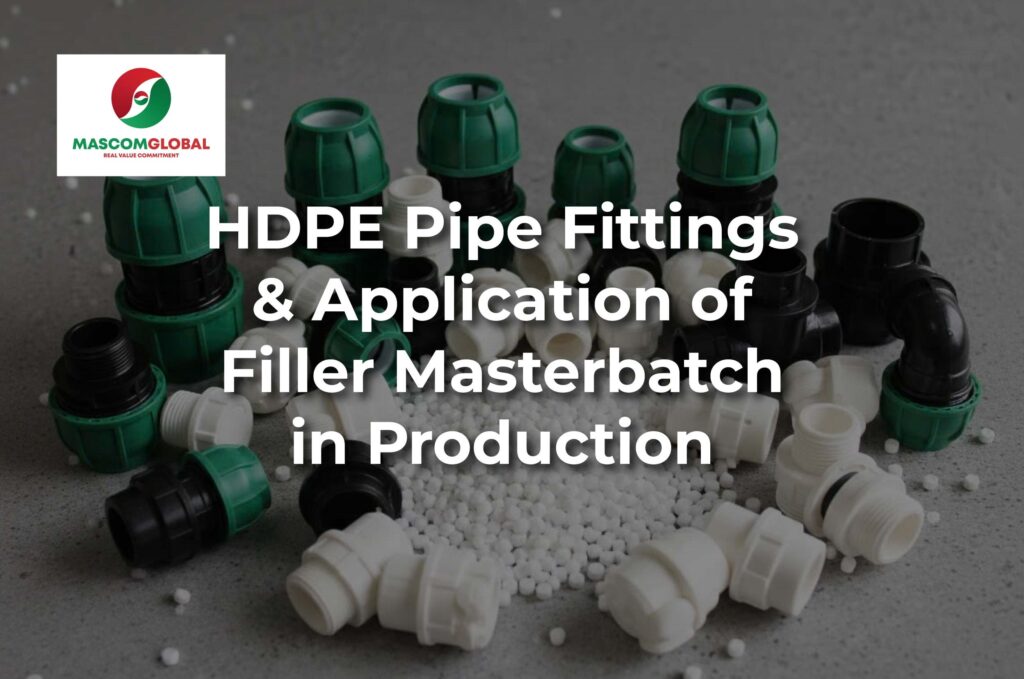
In the modern era, piping infrastructure serves as the lifeline of the economy, ranging from clean water supply and sewage treatment to the transportation of oil, gas, and chemicals. In this context, HDPE (High-Density Polyethylene) has emerged as a superior material. However, a piping system is only as strong as its connections — commonly known as HDPE Pipe Fittings. Beyond the stringent requirements for durability and safety, manufacturers face the constant challenge of optimizing production costs. The application of Filler Masterbatch (calcium carbonate filler) has become a strategic solution, enabling businesses to enhance their competitiveness while maintaining the essential physical and chemical properties of their products.
1. The Comprehensive Concept of HDPE Pipe Fittings
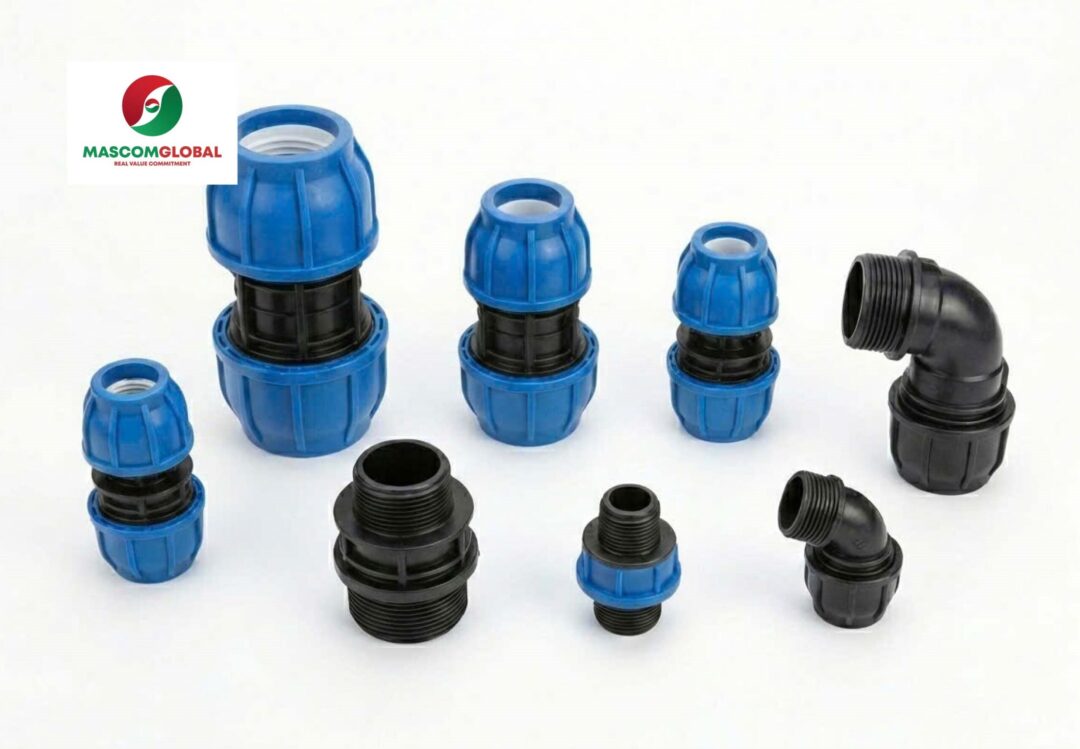
HDPE Pipe Fittings are precision-engineered components designed to join HDPE pipe sections into a continuous, leak-proof system. Due to the high density and toughness of HDPE resin, the fittings must also be manufactured from high-performance polymers to ensure uniformity in thermal expansion and load-bearing capacity.
Types of Fittings and Connection Mechanisms
The diversity of HDPE fittings serves various engineering purposes:
- Butt Fusion Fittings: Including tees, elbows, and reducers. They are joined by heating the ends of both the pipe and the fitting and pressing them together, creating a permanent bond as strong as the pipe itself.
- Electrofusion Fittings: These utilize internal heating coils to melt the joint surface. This is the most precise method, often mandatory for critical gas distribution networks.
- Compression Fittings: Using gaskets and threaded rings to create a mechanical seal.These are popular in irrigation systems or temporary lines due to their ease of installation and disassembly.
2. Manufacturing Challenges and the Strategic Role of Filler Masterbatch
The production of HDPE fittings typically employs Injection Molding technology. This process requires the molten plastic to have excellent flow properties to fill complex molds. However, virgin HDPE resin often exhibits significant shrinkage during the cooling phase, which can lead to warping or dimensional inaccuracies.
Filler Masterbatch is a concentrated mixture of high-quality CaCO3 powder, a PE carrier resin, and specialized dispersing agents. When blended with virgin resin, it acts not just as a bulk filler but as a “structural enhancer” for the final HDPE fitting.
3. Key Technical Benefits of Utilizing Filler Masterbatch
3.1. Dimensional Stability and Reduced Shrinkage
One of the primary issues with HDPE fittings is shrinkage after molding. By introducing CaCO3 into the plastic matrix, the mineral particles act as physical “anchors” that restrict the excessive contraction of polymer chains. This is vital for fittings that require high precision, such as threaded components or surfaces intended for heat fusion.
3.2. Enhanced Rigidity and Compressive Strength
While HDPE possesses excellent impact resistance, its inherent stiffness might not always be sufficient to withstand heavy overburden pressure in underground installations. Filler Masterbatch increases the elastic modulus of the product, making the fittings more rigid and resistant to mechanical deformation under long-term external loads.
3.3. Optimization of Cycle Time
In injection molding, cooling time accounts for the majority of the production cycle. Because CaCO3 has significantly higher thermal conductivity than virgin PE resin, the presence of the filler allows heat to dissipate from the product much faster. This enables manufacturers to shorten cooling times, thereby increasing hourly output and reducing overall energy consumption per unit.

4. Economic Analysis and Global Competitiveness
With the volatile prices of crude oil — the feedstock for virgin resins — the ability to replace 10% to 25% of virgin polymer with Filler Masterbatch provides a massive financial edge:
- Lower Production Costs: The cost per kilogram of Filler Masterbatch is substantially lower than that of virgin resin, allowing companies to offer more competitive pricing in the global market.
- Waste Reduction: Filler helps stabilize the melt flow, reducing scrap rates caused by air bubbles, sink marks, or surface imperfections.
5. Technical Precautions for Using Fillers in HDPE Fittings
To ensure high-quality outcomes, the application of fillers must adhere to strict technical guidelines:
- Particle Size: The CaCO3 powder within the masterbatch must be ultra-fine (measured in microns) to ensure surface smoothness and prevent clogging of the injection gates or extruder filters.
- Dispersion Quality: This is a non-negotiable factor. If the filler clumps together, these agglomerates become “stress concentration points”, which can cause the fitting to crack or fail when the system is under high internal pressure.
- Mixing Ratios: Generally, a ratio of 15- 20% is ideal to maintain the balance between flexibility and stiffness. Overloading the filler can make the fitting brittle and prone to catastrophic failure.
Conclusion
HDPE Pipe Fittings are more than just plastic connectors; they are the guarantee of safety and sustainability in modern infrastructure. The scientific application of Filler Masterbatch has proven its dual value: optimizing profits for manufacturers while enhancing critical mechanical properties of the products. A deep understanding of the interaction between the filler and the base resin is the key to producing high-quality fittings that meet the rigorous demands of global construction and industrial sectors.
